 Sunday 15 November 2026
 Ferhunde
Fast reflexes are essential in action games, but knowing when to defend, counterattack and use limited resources can be just as important. Witch the S...
See more
 Homepage
 Blog
Home Blog
China's Flying Taxi Projects: Is the Future of Urban Transportation in the Sky?
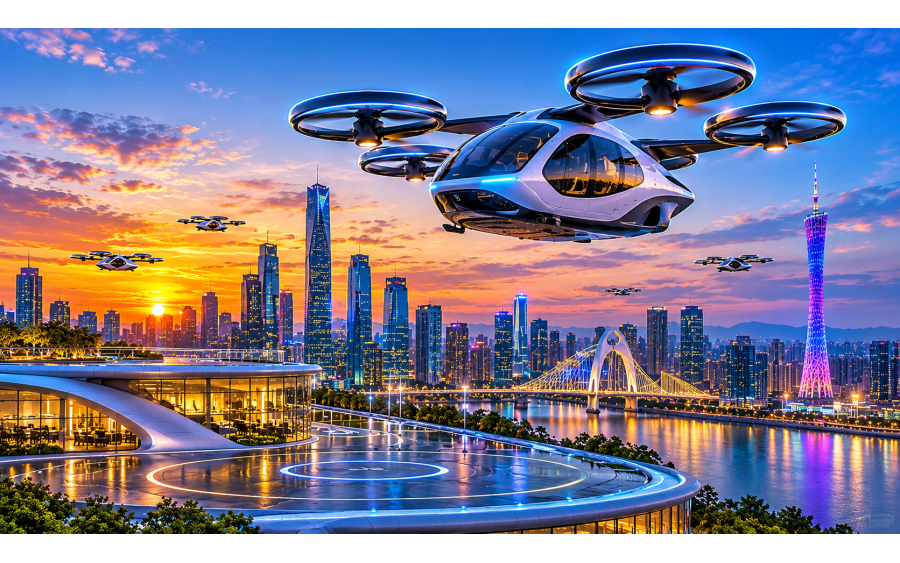
Traffic congestion, long travel times, and transportation challenges in major cities are pushing technology companies to develop alternative solutions. One of the countries leading these efforts is China. Bringing its investments in electric vehicles and drone technologies into the aviation sector, Chinese companies are now making significant progress in developing flying taxis designed for urban transportation.
Electric Vertical Take-Off and Landing (eVTOL) aircraft could enable people to travel from one point to another much faster in the future. Moreover, some of these vehicles are being designed to operate without pilots, relying entirely on autonomous systems.
So, what stage have China's flying taxi projects reached? Can these vehicles really become part of everyday transportation?
Flying taxis are aircraft that generally operate using electric motors and can take off and land vertically, unlike traditional helicopters. This technology is known as eVTOL, an abbreviation of "Electric Vertical Take-Off and Landing."
Some of the most important features of these vehicles include:
Vertical take-off and landing: They can take off and land from designated locations without requiring long runways.
Electric motors: They aim to produce lower local emissions compared to conventional fuel-powered aircraft.
Autonomous flight: Some models can operate without a pilot using advanced software and sensors.
Smart navigation: They use GPS, radar, and various sensors to detect their surroundings and navigate safely.
Reduced travel times: They offer an alternative transportation option, particularly in areas with heavy urban traffic.
The main purpose of flying taxis is not to completely eliminate road traffic, but to provide a faster alternative between specific transportation points within cities.
Several Chinese technology companies are developing eVTOL aircraft. These projects include autonomous passenger-carrying aircraft, personal flying cars, and larger electric air vehicles.
One of China's most remarkable projects is the EH216-S, developed by Guangzhou-based technology company EHang.
The EH216-S is an electric, pilotless aircraft designed to carry two passengers. Thanks to its multi-rotor configuration, it can take off and land vertically. Unlike conventional aircraft, it operates using autonomous flight technology.
One of the project's most important achievements is its success in the certification process. The EH216-S became one of the first pilotless passenger-carrying eVTOL aircraft to receive a type certificate, production certificate, and standard airworthiness certificate from the Civil Aviation Administration of China.
In March 2025, EHang's operating partners in Guangzhou and Hefei received the first commercial operating permits for pilotless passenger-carrying aircraft.
By 2026, preparations for launching paid aerial tourism services for the public in Guangzhou had also progressed. The company aims to establish short-distance air transportation routes and sightseeing flights across the city.
These developments demonstrate that flying taxi technology is moving beyond the prototype stage and getting closer to real-world applications.
Another Chinese company making significant progress in flying vehicle technology is XPeng AeroHT.
One of its most notable projects is a modular flying car concept that combines a road-going electric vehicle with an aircraft.
In this system, the ground vehicle can transport the aircraft module. When needed, users can detach the aerial module from the vehicle and use it for flight.
XPeng AeroHT aims to make personal air transportation more accessible. Unlike traditional flying taxi models, this approach also focuses on individual use and personal mobility.
The technologies being developed by the company could pave the way for a future in which vehicles are capable of traveling not only on roads but also in the sky under specific conditions.
Another notable Chinese eVTOL company is AutoFlight.
The company's Matrix model stands out from other small flying taxi projects in terms of passenger capacity.
Designed to weigh approximately five tons, the Matrix is a large-scale electric vertical take-off and landing aircraft targeting a passenger capacity of up to 10 people.
With a wingspan of approximately 20 meters, the aircraft demonstrates that electric air transportation may extend beyond small two-person vehicles.
AutoFlight's Matrix is still at the prototype stage. Therefore, it will need to complete the necessary certification processes and obtain operating permits before it can be used as a commercial passenger transportation service.
One of the most important questions about flying taxis is when this technology will become part of everyday life.
China is not only developing prototypes but is also conducting real-world flight operations and infrastructure projects.
In cities such as Guangzhou and Hefei, EHang is carrying out regular trial operations using pilotless aircraft.
In April 2026, plans were announced to launch public paid aerial sightseeing flights in Guangzhou's Huangpu district in cooperation with EHang. The project aims to offer short sightseeing flights with views of the city.
However, an important distinction must be made: the operation of sightseeing flights does not mean that flying taxis are already providing citywide transportation services, allowing passengers to travel between any locations they choose.
Regular urban transportation will require more flight routes, landing facilities, air traffic management systems, and safety infrastructure.
If flying taxis become widespread, they could significantly change urban transportation habits.
Travel times between distant locations could be reduced considerably, especially in major cities where people spend long periods commuting.
For example, a journey that takes a long time by road in a heavily congested city could potentially be completed much faster using a designated air transportation route.
Potential future applications of flying taxis include:
Airport transportation: Faster transfers between city centers and airports.
Business travel: Quick journeys between major business districts in large cities.
Tourism: Exploring cities and natural attractions from the air.
Emergency medical services: Rapid transportation of medical teams or essential supplies using suitable aircraft.
Intercity transportation: Alternative transportation options for short and medium-distance routes.
However, not every flying taxi will be capable of performing all these tasks. The vehicle's passenger capacity, range, and technical specifications will determine its potential applications.
Although flying taxis are considered one of the potential transportation solutions of the future, several important challenges must be overcome before this technology can become widespread.
1. Battery Capacity and Flight Range
One of the biggest limitations of electric aircraft is battery technology. Vertical take-off requires a significant amount of energy. Battery capacity and energy efficiency must improve to enable safer and longer-distance flights.
2. Flight Safety
Safety is the most important factor when it comes to aircraft carrying passengers. How autonomous systems respond to unexpected situations, how they handle motor failures, and how they manage emergency landings are all critical considerations.
3. Air Traffic Management
Operating thousands of flying taxis within the same city would require carefully organized airspace management. Advanced traffic management systems would be essential to prevent collisions between aircraft.
4. Take-Off and Landing Infrastructure
Special facilities must be established in cities for flying taxis to take off and land. These facilities are generally known as vertiports.
5. Cost and Accessibility
Flying taxi services are expected to be expensive during their early stages. As the technology becomes more widespread, manufacturing costs decrease, and more companies enter the market, prices may gradually become more affordable.
China's investments in flying taxis are not limited to a few technology companies developing aircraft. The country is working toward creating a much broader economic ecosystem covering air transportation and other commercial activities at low altitudes.
This approach is known as the "Low-Altitude Economy."
Within this economic model, flying taxis, cargo drones, aerial tourism, emergency response vehicles, and electric aircraft are all considered part of the same ecosystem.
New landing facilities, maintenance centers, charging stations, and air traffic management systems are also essential components of this strategy.
Cities such as Guangzhou, Shenzhen, and Hefei are playing an important role in the development of China's low-altitude economy, particularly as technology and manufacturing hubs.
Although the future of flying taxis is exciting, these vehicles are not expected to replace traditional cars anytime soon.
In the early stages, airport transfers, sightseeing flights, and private journeys along designated routes are likely to become the primary applications.
Over time, improvements in battery technology, lower manufacturing costs, and enhanced flight safety could make these services accessible to a much wider audience.
The projects being developed by Chinese companies such as EHang, XPeng AeroHT, and AutoFlight represent important examples of this transformation.
China's flying taxi projects provide important clues about how urban life could change in the future. Thanks to electric motors, autonomous flight systems, and advanced sensor technologies, air transportation is preparing to enter a new era.
Although flying taxis are not yet a widespread transportation system available in every city, certification efforts, testing programs, and commercial operations in China are accelerating the transition of this technology into real-world applications.
Perhaps in the future, instead of using our cars to commute to work, reach the airport, or travel to another part of the city, we will simply choose a flying taxi.
Could the sky become a new highway for the future of urban transportation? In the coming years, we may have a much clearer answer to this question.

Fast reflexes are essential in action games, but knowing when to defend, counterattack and use limited resources can be just as important. Witch the S...
See more