 Monday 10 August 2026
 Ferhunde
What Causes Stuttering in Games? Common Reasons and How to Fix It Stuttering is one of the most common performance issues gamers encounter while play...
See more
 Homepage
 Blog
Home Blog
How Will Quantum Computing Affect Video Games? The Future of the Gaming World
Blog
Home Blog
How Will Quantum Computing Affect Video Games? The Future of the Gaming World
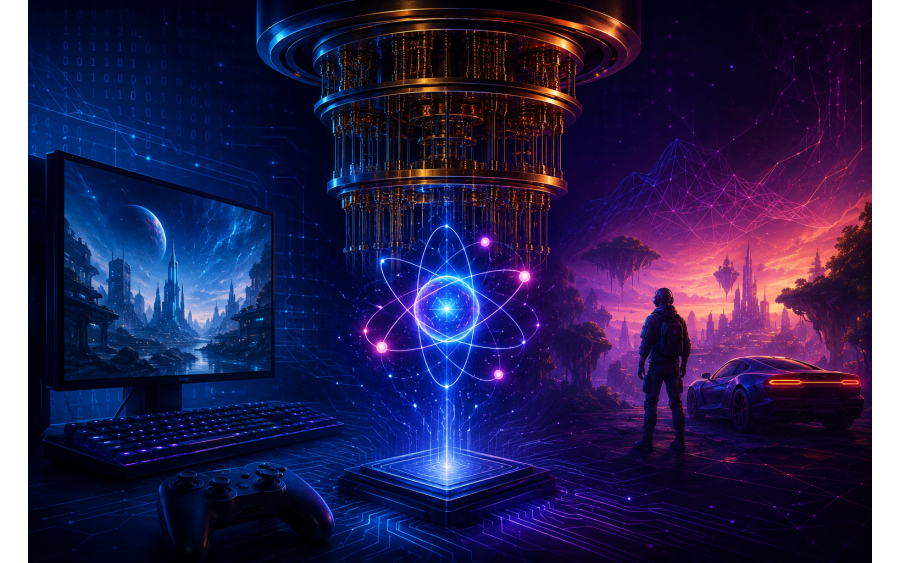
One of the most remarkable developments in the technology world in recent years, quantum computers, could significantly transform not only scientific research and data processing technologies but also the world of digital gaming in the future. Although quantum computers are not yet advanced enough to replace the computers we use at home, new possibilities for gaming technology are expected to emerge as the technology develops.
So, how could quantum computers affect video games? What changes could we see in areas such as graphics, artificial intelligence, game-world generation, and online gaming experiences?
Traditional computers process information using units called bits, which can have a value of either 0 or 1. Quantum computers, on the other hand, use quantum bits known as qubits.
Qubits take advantage of the principles of quantum mechanics, potentially making it possible to solve certain specialized problems using methods that can be significantly more efficient than traditional computing approaches.
However, there is an important point to keep in mind: quantum computers are not "supercomputers" that perform every task faster than classical computers. Their advantages are expected to emerge particularly in certain mathematical, optimization, and simulation problems.
Therefore, the impact of quantum computers on the gaming industry may not simply mean higher FPS.
One of the most interesting potential applications of quantum computers in gaming could be artificial intelligence.
Today, game developers use various AI systems to control the behavior of enemies, NPCs, and other characters. If quantum computing becomes useful for certain optimization problems, it could potentially help calculate much more complex game behaviors in the future.
Imagine a large open-world game where hundreds of NPCs are moving around simultaneously.
Each character may have to consider numerous variables, such as:
Where they are,
Where they want to go,
Their relationships with other characters,
How they will react to the player's actions,
Events taking place in their surroundings.
If quantum computing becomes useful for solving certain complex optimization problems, it could potentially contribute to making these systems much more sophisticated.
One of the most important features of open-world games is their ability to provide players with large and living environments.
However, as the size of a game world increases, so does the computational workload required to simulate it.
If quantum computers become capable of handling certain simulation and optimization tasks in the future, developers could potentially create more complex and dynamic worlds.
Imagine a city-building game where thousands of vehicles, citizens, companies, and economic systems interact with one another.
Even a small decision made by the player could affect the city's economy, traffic density, or population movement.
If quantum computing can be used to model certain parts of these complex systems, it could contribute to creating more living and responsive game worlds.
Physics engines are an important part of modern video games.
From vehicle movement and character interactions with the environment to destructible objects, water, and air simulations, many game systems rely on physics calculations.
If quantum computers eventually provide advantages for certain physical and mathematical problems, developers could gain new methods for implementing more complex simulations.
For example:
More realistic environmental interactions → More advanced physics → More dynamic game worlds
could become a possible development path.
However, for this to happen, quantum hardware would need to improve significantly, and practical solutions capable of working alongside game engines would need to emerge.
When people hear about quantum computers, graphics may be one of the first things that come to mind for gamers.
However, expecting quantum computers to directly replace graphics cards is not realistic at present.
Today, high-quality game graphics rely primarily on GPUs, ray tracing technologies, AI-powered image generation, and advanced graphics engines.
If quantum computers become useful for certain specialized calculations involved in graphics production, they could potentially contribute to game development processes.
Possible areas of research could include:
More advanced lighting calculations,
Complex optimization processes,
Procedural content generation,
Large-scale simulations.
Therefore, the impact of quantum computers on gaming graphics is more likely to involve a new computational layer working alongside GPUs and classical computers, rather than replacing GPUs entirely.
Procedural generation refers to the creation of game worlds using specific algorithms and rules.
This technology already plays an important role in large open-world and exploration games.
With more powerful computational methods in the future, the following could potentially be generated according to much more complex rules:
Planets,
Cities,
Caves,
Maps,
Quests,
Characters,
Economic systems.
Imagine a game where players experience a different world every time they play.
The world could continuously change according to the player's actions, meaning that every player could have a completely different gaming experience.
If quantum computing becomes a useful supporting technology for some of the optimization problems involved in this process, personalization of game worlds could potentially reach a new level.
Matching players with the right opponents or teammates in online games is a highly complex problem.
A matchmaking system may need to consider several factors simultaneously, including:
Player skill level,
Skill rating,
Ping,
Region,
Team balance,
Player preferences.
When the number of players reaches millions, this problem becomes even more complicated.
If quantum optimization methods become sufficiently advanced in the future, they could potentially provide alternative approaches for solving large-scale optimization problems like these.
In theory, this could help developers create more balanced and efficient matchmaking systems.
The impact of quantum computers may not be limited to the games players see and experience.
Game developers themselves could potentially benefit from this technology.
For example, imagine a developer trying to find the best combination among hundreds of different gameplay mechanics.
Similarly, there can be a huge number of variables involved in areas such as:
Map design,
Character attributes,
Economic systems,
Quest distribution,
Resource management,
Game balancing.
If quantum optimization algorithms become effective for certain types of problems, they could help developers evaluate and optimize these possibilities.
One of the more realistic ways quantum computers could be used in gaming may be through cloud-based quantum computing services, rather than putting a quantum processor inside a player's home computer.
In this model, the player's computer could handle traditional gaming tasks while certain specialized calculations are performed remotely on quantum computing servers.
However, there is an important challenge here: latency.
In a video game, even a delay of milliseconds can significantly affect the gaming experience.
For this reason, using quantum computers for real-time gaming would require not only sufficient processing power but also major improvements in communication and network infrastructure.
Another area where quantum computers could affect the gaming industry is cybersecurity.
Online games rely on various security systems to protect user accounts, payment information, digital products, and in-game economies.
It is expected that sufficiently powerful quantum computers could eventually pose a threat to some existing cryptographic methods.
As a result, game companies may gradually need to adopt new security methods known as post-quantum cryptography.
This transition could be particularly important for:
Digital game stores,
Gaming accounts,
Payment systems,
Cloud services,
In-game purchases.
Probably not.
At least in the near future, gamers are not expected to completely abandon traditional computers and switch to quantum computers.
Quantum computers currently require highly specialized hardware, control systems, and environmental conditions, making them extremely complex machines.
Therefore, a more likely future scenario could involve classical computers + GPUs + AI accelerators + cloud-based quantum computers working together.
In other words, players may continue to play games on conventional computers while developers use quantum technologies behind the scenes.
There is no definitive answer to this question.
Quantum computing is still a rapidly developing field of research, and its practical applications depend heavily on advances in hardware and algorithms.
Therefore, over the next few years, we are more likely to see research projects and cloud-based experiments rather than "quantum-powered graphics" or "quantum gaming PCs."
In the long term, if quantum computers can demonstrate meaningful advantages for specific problems and the technology becomes scalable, more applications could emerge within the gaming industry.
Quantum computers are not yet mature enough to transform the gaming industry. However, they have the potential to play an important role in certain areas of gaming technology in the future.
New opportunities could emerge particularly in computationally complex areas such as artificial intelligence, optimization, physics simulations, procedural content generation, game economies, and online matchmaking.
At the same time, quantum computers are not expected to directly translate into higher FPS for gamers. A more likely scenario is that this technology will operate behind the scenes, helping developers create games that are more complex, dynamic, and personalized.
Perhaps the biggest technological innovation in the games we play in the future will not be the graphics we see on the screen, but rather the computational systems working behind the scenes.
Although the impact of quantum computers on the gaming world is still largely a subject of future research, it is already exciting to imagine how the gaming industry could evolve alongside this technology.
What Causes Stuttering in Games? Common Reasons and How to Fix It Stuttering is one of the most common performance issues gamers encounter while play...
See more

Helldivers 2 continues to attract players more than two years after its original release. Developed by Arrowhead Game Studios and published by Sony In...
See more
