 Friday 13 November 2026
 Ferhunde
Artificial intelligence has evolved far beyond chatbots that simply answer questions. Modern AI systems can write code, analyse documents, interact wi...
See more
 Homepage
 Blog
Home Blog
NASA's Nuclear-Powered Lunar Rover PROMISE: How Will Electricity Be Generated on the Moon?
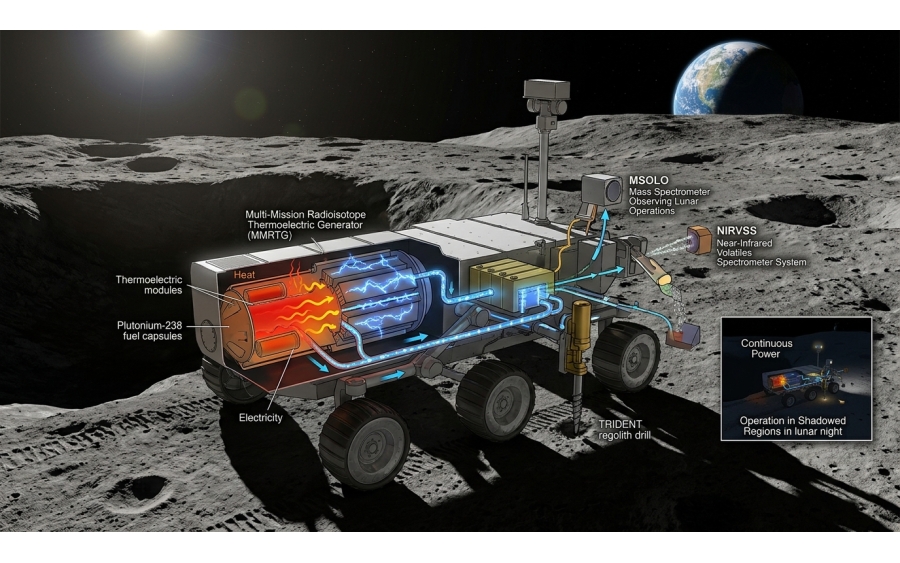
Humanity's goal of returning to the Moon and establishing a permanent presence there is driving significant advances in space technology. As part of this effort, NASA is preparing to explore previously underinvestigated regions of the Moon through a series of next-generation projects. One of these projects is a nuclear-powered lunar rover called PROMISE (Polar Rover for Observation, Mapping, and In-Situ Exploration).
Developed by NASA, PROMISE is designed to conduct research in the Moon's South Pole region, detect valuable resources such as water ice, and collect important data to support the development of a future lunar base.
But how will a spacecraft generate electricity in areas where sunlight never reaches? And why is nuclear energy so important for lunar exploration?
PROMISE is a large, six-wheeled exploration rover designed by NASA to investigate the Moon's South Pole. Managed by NASA's Jet Propulsion Laboratory (JPL), the project builds on technologies previously used in Mars exploration missions.
The rover is specifically designed to investigate permanently shadowed regions of the Moon. Scientists believe these areas may contain water ice and other valuable resources that have long been the subject of scientific research.
The main objectives of PROMISE include:
Examining the lunar surface and subsurface in detail.
Drilling to depths of approximately one meter to search for water ice and other materials.
Analyzing the chemical composition of lunar soil.
Measuring surface temperatures and radiation levels.
Helping identify suitable locations for a future lunar base.
Testing autonomous driving capabilities and advanced computer systems in the space environment.
According to NASA's plans, PROMISE is targeted for launch toward the end of 2028 and is expected to operate on the lunar surface for approximately 18 months.
Generating electricity on the Moon presents very different challenges compared to Earth. This is because the Moon has no atmosphere, and sunlight does not reach every region continuously.
In particular, some permanently shadowed areas near the lunar poles have not received direct sunlight for billions of years. Temperatures in these regions can drop to extremely low levels.
Since solar panels cannot generate sufficient energy in areas where sunlight is unavailable, NASA needs alternative power systems.
PROMISE will address this challenge using a system called the Multi-Mission Radioisotope Thermoelectric Generator (MMRTG).
This system converts the heat released during the natural radioactive decay of certain materials into electrical energy.
An important distinction is that PROMISE's power system does not generate electricity through a controlled nuclear fission reaction, as conventional nuclear power plants do. Instead, it relies on the natural decay of radioisotopes.
Thanks to this technology, the rover will be able to generate electricity without depending on sunlight.
MMRTG is a power system developed to provide reliable, long-lasting energy for space missions.
Its operating principle is quite interesting:
Radioisotopes such as plutonium-238 inside the generator naturally decay.
This decay continuously releases heat.
Thermoelectric components use the temperature difference to generate electricity.
The electricity produced powers the rover's computers, cameras, scientific instruments, and other systems.
One of the biggest advantages of this technology is that it can provide energy for extended periods without requiring moving mechanical parts.
NASA has previously used similar MMRTG technology in Mars exploration rovers such as Curiosity and Perseverance. For the PROMISE project, one of the spare units developed for these missions will be used.
Solar panels are a highly useful energy source for space missions. However, the challenging environmental conditions around the Moon's South Pole can limit their effectiveness.
Solar energy is particularly difficult to use in permanently shadowed regions, where sunlight never reaches the surface.
Radioisotope-based nuclear power systems eliminate this limitation.
The main advantages of PROMISE's power system include:
Continuous power: It can generate electricity without depending on sunlight.
Long mission duration: It can provide energy for extended space exploration missions.
Resistance to extreme cold: It supports operations in regions with extremely low lunar temperatures.
Exploration of shadowed regions: It makes research possible in areas where sunlight is unavailable.
Reliable operation: The limited number of moving mechanical parts makes the system suitable for long-duration missions.
These capabilities are also extremely important for future scientific research centers and habitats planned for the Moon.
One of the main reasons NASA is particularly interested in the Moon's South Pole is the possibility of finding water ice there.
Scientists believe that permanently shadowed craters may contain water ice and other volatile substances that have been preserved for billions of years.
PROMISE will be equipped with advanced scientific instruments to investigate these potential resources.
Its specialized drilling system will be capable of extracting samples from approximately one meter below the lunar surface. The collected materials will then be examined using various analytical instruments.
These investigations will help scientists:
Determine the amount of water ice present in lunar soil.
Examine the mineral and chemical composition of the region.
Evaluate the resource potential for future human missions.
Identify suitable locations for future lunar bases.
Finding water on the Moon would be extremely important for future space missions. In addition to being used as drinking water, it could potentially be processed into oxygen and rocket propellant using appropriate technologies.
One of NASA's long-term goals is to establish a lunar base where humans can live for extended periods and conduct scientific research.
However, sending astronauts to the Moon is not enough to achieve this goal. Essential needs such as electricity generation, communication, transportation, shelter, and resource utilization must also be addressed.
PROMISE is expected to play an important role in this preparation process.
The rover will investigate environmental conditions around the Moon's South Pole and collect scientific and technical data for future missions. It will also test advanced autonomous driving capabilities, allowing it to operate more independently without constantly waiting for commands from Earth.
NASA's ability to draw on experience gained from Mars rovers such as Curiosity and Perseverance is another important advantage in the development of this project.
The PROMISE project once again demonstrates just how important energy sources are for space exploration.
Future lunar habitats will not be limited to short-term missions. To support humans living on the Moon for extended periods, reliable, continuous, and high-capacity power systems will be essential.
Alongside radioisotope power systems such as the one planned for PROMISE, NASA is also working on nuclear fission reactors that could be used on the lunar surface.
Although these two technologies operate differently, they share the same objective: generating reliable electricity on the Moon without depending on sunlight.
In particular, nuclear fission systems are expected to provide much higher levels of electrical power for future lunar bases. This could allow habitats, communication networks, scientific laboratories, and various exploration vehicles to operate with a continuous energy supply.
NASA's PROMISE project represents an important step toward exploring previously undiscovered regions of the Moon and preparing the infrastructure for future human missions.
Thanks to its nuclear-powered MMRTG system, the rover will be able to operate in dark and extremely cold regions where sunlight never reaches.
The mission, targeted for launch toward the end of 2028, could make significant contributions to the exploration of lunar resources and the planning of future lunar bases.
Energy generation will be one of the most important challenges in making permanent human life on the Moon possible. PROMISE is preparing to become one of the important examples of the technologies being developed to achieve this ambitious goal.
-360x225.jpg)
Artificial intelligence has evolved far beyond chatbots that simply answer questions. Modern AI systems can write code, analyse documents, interact wi...
See more