 Tuesday 25 August 2026
 Ferhunde
How Is Artificial Intelligence Changing Our Daily Lives? Artificial intelligence (AI) has become an important part of everyday life in recent years, ...
See more
 Homepage
 Blog
Home Blog
What Is 5G? What Is the Difference Between 4G and 5G? Everything You Need to Know About 5G Technology
Blog
Home Blog
What Is 5G? What Is the Difference Between 4G and 5G? Everything You Need to Know About 5G Technology
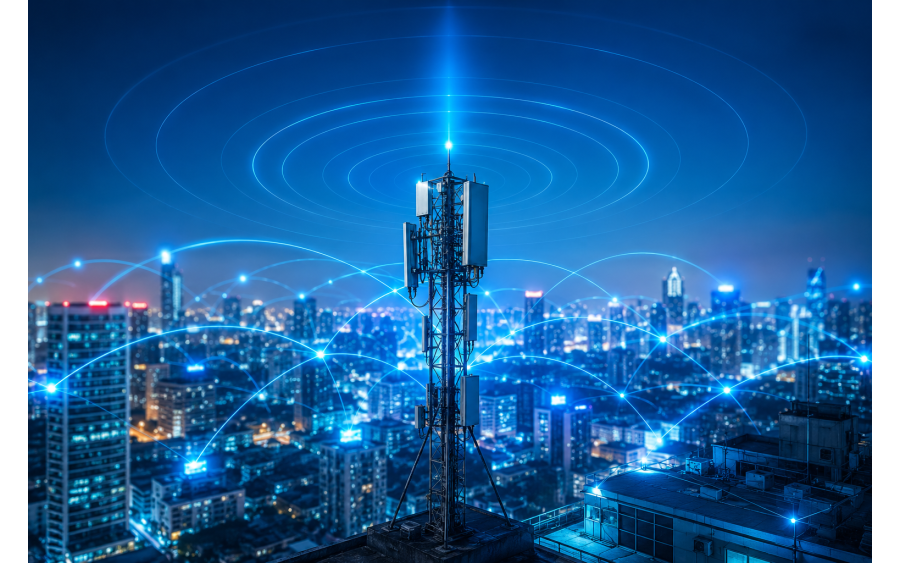
Mobile internet technologies are becoming faster and more advanced every day. From smartphones, tablets, and computers to smart home devices and autonomous systems, many technologies require powerful and low-latency internet connections. At this point, 5G technology stands out as one of the most important developments in the world of mobile communications.
So, what is 5G and how is it different from 4G? How much faster is 5G compared to 4G, and how could it change our daily lives? In this article, we take a detailed look at how 5G technology works, its advantages, the differences between 4G and 5G, and the possibilities it may offer in the future.
5G stands for "Fifth Generation" and refers to the fifth generation of mobile communication technology. Developed as the successor to 4G, 5G is designed not only to provide higher internet speeds but also lower latency, greater connection capacity, and the ability to connect many more devices to the internet simultaneously.
With 5G, smartphones can benefit from faster internet connections, while technologies such as smart cities, the Internet of Things (IoT), autonomous vehicles, industrial automation, and advanced virtual reality applications can operate more efficiently.
5G uses different frequency bands to provide faster and more efficient data communication between devices and base stations.
5G networks can use low-, mid-, and high-frequency bands. High-frequency bands, in particular, can provide extremely high data speeds. However, because these frequencies can have a shorter coverage range, they may require more base stations and advanced infrastructure.
5G networks also use technologies such as beamforming. Beamforming allows the signal to be directed more effectively toward the device it is communicating with. This helps the network use the connection more efficiently.
4G is the fourth generation of mobile communication technology. It played a major role in the widespread adoption of mobile internet and provided significantly higher speeds and lower latency compared to previous generations.
Watching videos, browsing social media, playing online games, making video calls, and downloading files became much easier on mobile devices thanks to 4G.
However, the increasing number of devices connected to the internet and the growing demand for higher data speeds have created a need for more advanced mobile communication infrastructure. 5G was developed to address these needs.
The most important differences between 5G and 4G are speed, latency, connection capacity, and use cases.
One of the most notable features of 5G is its high data transfer speed. Under suitable conditions and with the right infrastructure, 5G can achieve much higher download and upload speeds than 4G.
This can provide significant advantages when downloading large files, watching high-resolution videos, and using cloud-based applications.
However, actual speeds can vary depending on the frequency band being used, the operator's infrastructure, the distance from the base station, the capabilities of the device, and network congestion.
Latency is the amount of time it takes for data to travel from a device to a server and back.
One of the key advantages of 5G is that, under suitable network conditions, it can offer significantly lower latency than 4G.
Low latency can be particularly important for:
Today, smartphones and computers are not the only devices connected to the internet. Smartwatches, security cameras, cars, home appliances, sensors, and various IoT devices also rely on constant internet connectivity.
5G is designed to support communication between a much larger number of devices within the same area. Therefore, it can play an important role in the development of Internet of Things (IoT) technologies.
In places such as concerts, stadiums, airports, or city centers, large numbers of people may try to access the internet at the same time, creating network congestion.
5G can help support a larger number of devices simultaneously by providing higher network capacity and more efficient communication.
The main advantages of 5G technology can be summarized as follows:
The impact of 5G may go far beyond simply providing faster internet on smartphones.
For example, cloud gaming technology allows games to run on remote servers instead of requiring a powerful computer or game console. Lower latency and higher connection speeds can help these services provide a better user experience.
Similarly, faster data transfer can enable more advanced and real-time experiences in virtual reality and augmented reality applications.
In smart cities, traffic systems, security cameras, energy management systems, and various sensors can continuously communicate with each other.
5G can offer significant advantages, particularly for mobile and cloud-based gaming.
Lower latency can help transmit a player's actions to the game server more quickly. This can be especially important in competitive online games.
However, using 5G does not automatically guarantee low ping. Factors such as the location of the game server, internet infrastructure, network congestion, and the device being used can also affect gaming performance.
Therefore, while 5G can provide an important advantage on the connectivity side, it does not determine overall gaming performance by itself.
Having a 5G-compatible smartphone alone is not enough to use a 5G connection. Generally, the following requirements must also be met:
Therefore, purchasing a 5G-compatible device does not automatically mean that you will be able to use a 5G connection everywhere.
Generally, no. A 4G phone cannot connect to a 5G network if its hardware does not support 5G connectivity.
Users who want to access 5G need a smartphone or another compatible device equipped with a 5G modem.
However, 5G-compatible smartphones can generally also connect to 4G networks. This allows the device to use a 4G connection when it is outside a 5G coverage area.
Although 5G offers many advantages, it also has some limitations.
First, building and expanding 5G infrastructure requires significant investment. In addition, some high-frequency 5G technologies may have more limited coverage areas.
The cost of 5G-compatible devices can also be higher than that of 4G devices, particularly during the early stages of the technology.
The quality of the 5G experience may also vary from one location to another. Factors such as the user's location, base station density, frequency band, and the operator's infrastructure can directly affect connection performance.

How Is Artificial Intelligence Changing Our Daily Lives? Artificial intelligence (AI) has become an important part of everyday life in recent years, ...
See more

How Useful Are Smartwatches Really? Advantages, Features, and Things to Consider A few years ago, smartwatches were mostly seen as technological acce...
See more