

 Monday 14 September 2026
 Ferhunde
Bus simulation games are no longer limited to simply getting behind the wheel and transporting passengers from one stop to another. Modern simulation ...
See more
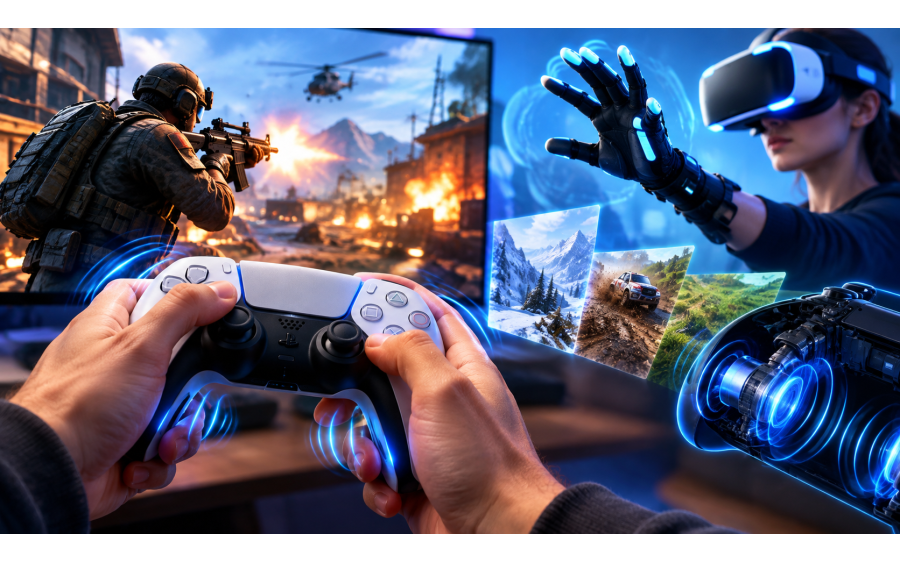
The gaming world is constantly adopting new technologies to provide more realistic and immersive experiences. Alongside technologies such as high-resolution graphics, realistic sound effects, ray tracing, and virtual reality, haptic feedback technology is also becoming an increasingly important part of the gaming experience.
So, what is haptic feedback? Are the vibrations players feel during gameplay simply an effect, or can they actually make games feel more realistic?
In this article, we will explore what haptic feedback technology is, how it is used in games, and how it can change the gaming experience.
Haptic feedback is a technology that provides information to users through physical contact, vibrations, or other tactile sensations. Also known as "haptic feedback," this technology allows players not only to see and hear events happening on the screen but also to physically feel them.
For example, when a controller vibrates as a car hits a curb in a racing game, when a trigger provides resistance as a weapon is fired in an FPS game, or when a controller produces different vibration patterns when a character takes damage, these are all examples of haptic feedback.
This technology makes the interaction between the player and the game world more physical and immersive.
The use of haptic technology in games is no longer limited to traditional vibrations. Modern gaming controllers can create much more detailed physical sensations thanks to advanced haptic motors and different levels of vibration intensity.
For example:
Providing different recoil sensations for different weapons
Simulating the vibration of a vehicle engine
Representing raindrops through subtle vibration patterns
Creating different sensations when a character walks across different surfaces
Physically conveying explosions and collisions
Providing different resistance levels through controller triggers
These features can help players become more deeply immersed in the game world.
The vibration systems found in older generations of gaming controllers were generally quite simple. When an event occurred, the controller would vibrate at a certain intensity, and there was little additional information for the player to experience.
Modern haptic feedback systems, however, can control the intensity, duration, and pattern of vibrations much more precisely.
For example, different feedback can be created depending on the type of weapon a character is holding. A light pistol does not have to feel the same as a powerful rifle when fired.
Similarly, driving across asphalt, gravel, or mud can create different physical sensations for the player.
This makes haptic feedback more than just a "vibration effect" and turns it into an important part of modern game design.
The short answer is yes.
However, realism is not measured only by graphical quality, so the impact of haptic feedback is somewhat different. While graphics make the world players see more realistic, haptic technologies help players physically experience events taking place within the game world.
For example, seeing a character hit a door is visual information. Feeling a small impact through the controller at the same moment allows the brain to perceive the event through another sense.
Combining sight, sound, and touch can make it easier for players to feel as though they are actually inside the game.
One of the most impressive applications of haptic feedback technology is virtual reality (VR).
While VR headsets allow players to see and explore virtual worlds, haptic devices can make it possible to physically experience some of the interactions within those worlds.
For example, touching a virtual object, using a weapon, or interacting with a surface can be supported by different types of physical feedback.
In the future, as haptic gloves, specialized suits, and advanced control systems become more widespread, players may be able to experience virtual objects in much more realistic ways.
The future of haptic feedback technology does not appear to be limited to gaming controllers. Haptic gloves and wearable devices can provide different types of feedback through the player's hands and body.
Imagine a player holding a virtual object. In traditional VR systems, the player can see the object but does not actually hold a physical object in their hands.
Haptic gloves aim to make this interaction more realistic by applying different types of feedback to the fingers and hands.
As these technologies continue to develop, touching and physically interacting with virtual environments could become just as common as seeing and hearing them in future games.
One of the most important advantages of haptic feedback technology is that it strengthens the interaction between the player and the game.
Some of its main benefits include:
In a horror game, a door suddenly closing or an object falling behind the character can be supported not only by sound effects but also by physical feedback. This can make the atmosphere even more immersive and impactful.
In racing games, conveying road surfaces, collisions, and vehicle movements through different physical sensations can make the driving experience feel more realistic.
Actions such as using weapons, collecting objects, opening doors, or interacting with different surfaces can become more noticeable and engaging through haptic feedback.
Because physical feedback allows players to experience events in the game world more directly, it can increase immersion and help players feel more connected to the game.
Although haptic feedback technology can enhance the gaming experience, it is not equally important in every type of game.
For example, in a competitive FPS game, precise feedback can help players better perceive weapon handling and events happening around them.
On the other hand, in a calm, story-driven strategy game, the impact of haptic technology may be much more limited.
Therefore, the success of haptic feedback depends not only on the hardware being used but also on how effectively the game utilizes the technology.
As technology continues to advance, haptic feedback systems are expected to become more precise and sophisticated.
In the future, players may be able to:
Feel the shape of virtual objects
Distinguish between different surfaces
Experience impacts and collisions more realistically
Come closer to feeling the weight or resistance of objects
Interact more naturally with virtual environments in VR
In particular, the combination of artificial intelligence, virtual reality, augmented reality, and advanced haptic technologies could bring significant changes to the gaming experience.
Perhaps in the future, players will not simply control characters on a screen but will feel as though they are actually part of the game world.

Bus simulation games are no longer limited to simply getting behind the wheel and transporting passengers from one stop to another. Modern simulation ...
See more
What Is the Difference Between AMOLED and OLED Displays in Smartphones? When buying a smartphone, display technology is just as important as the proc...
See more
