

 Friday 18 September 2026
 Ferhunde
Can Haptic Feedback Technology Make Games More Realistic? The gaming world is constantly adopting new technologies to provide more realistic and imme...
See more
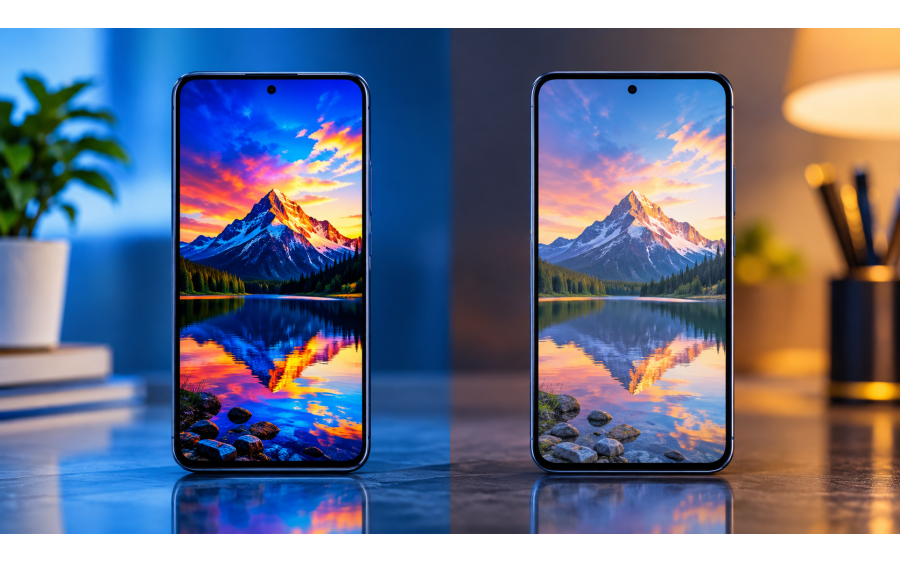
When buying a smartphone, display technology is just as important as the processor, camera, and battery capacity. Today, OLED and AMOLED display technologies are found in many smartphones. But what is the difference between AMOLED and OLED? Are these two display technologies really that different from each other?
Both technologies offer important advantages such as vibrant colors, high contrast, and thin display designs. However, there are some differences in their underlying structures and technologies.
OLED (Organic Light Emitting Diode) is a display technology based on organic light-emitting diodes. Unlike LCD displays, OLED screens do not require a separate backlighting system to create images.
In OLED technology, pixels produce their own light. This means that when displaying black, the relevant pixels can be completely turned off. As a result, OLED displays can achieve very high contrast ratios.
The main features of OLED displays include:
High contrast ratios
Realistic and vibrant colors
Deeper blacks
Thin display designs
Wide viewing angles
No need for a backlight
These features have made OLED displays increasingly popular, especially in smartphones.
AMOLED (Active Matrix Organic Light Emitting Diode) is a type of OLED technology. AMOLED displays use an active matrix structure to control OLED pixels.
Thanks to the active matrix system, pixels can be controlled more quickly and precisely. This can be particularly beneficial for modern smartphone displays with high resolutions and high refresh rates.
Like OLED technology, AMOLED displays use pixels that produce their own light. Therefore, AMOLED displays also do not require a separate backlighting system.
In fact, AMOLED is a subtype of OLED technology. Therefore, comparing "OLED vs. AMOLED" is not exactly a comparison between two completely independent technologies.
The main difference lies in how the pixels are controlled.
OLED refers to a broader family of display technologies, while AMOLED refers to an OLED display in which pixels are controlled using an active matrix system.
For this reason, AMOLED displays used in modern smartphones can offer highly advanced features such as high resolution, fast response times, and high refresh rates.
Both display technologies offer several important advantages for smartphones.
In OLED-based displays, pixels can be completely turned off when necessary. This allows black areas to appear truly black or very close to true black.
On LCD displays, there is a backlight, so some light can still be visible even in areas that are supposed to be black.
Because individual pixels produce their own light, very bright and very dark areas can be displayed more distinctly within the same image.
This feature can provide a more immersive viewing experience, especially when watching movies and TV shows or playing games.
OLED-based displays do not require the backlighting layer found in traditional LCD panels. This can help manufacturers create thinner display designs.
Smartphone manufacturers can take advantage of this feature to create slimmer and more modern devices.
OLED-based displays can change pixels quickly, which can provide advantages when displaying moving images.
This is particularly important for gaming, especially on displays with high refresh rates.
The power consumption of OLED displays varies depending on the content being displayed. When an image contains many black areas, some pixels can be completely turned off, potentially reducing power consumption.
For this reason, OLED-based displays can provide power-efficiency benefits in certain situations, especially when using dark themes in apps.
Although AMOLED displays offer many advantages, they can also have some disadvantages.
One of these is the risk of screen burn-in. Displaying the same image or static interface elements for long periods can cause some pixels to age differently from others.
Modern smartphones use various software and hardware measures to reduce this risk, but it cannot be said to have been completely eliminated.
In addition, OLED-based displays can have higher manufacturing costs than some LCD displays. This can also affect the price of smartphones.
There is no single answer to this question because AMOLED is already a type of OLED technology.
When choosing a smartphone, it is more useful to evaluate the following features together rather than looking only at whether the display is OLED or AMOLED:
Display resolution
Refresh rate
Maximum brightness
Color accuracy
HDR support
Display size
Power consumption
Technologies used to reduce the risk of screen burn-in
For example, two different AMOLED displays may not offer the same level of quality. Factors such as panel manufacturing technology, brightness level, color calibration, and other display technologies can have a significant impact on image quality.
When buying a new smartphone, you should not focus only on whether the display is labeled "AMOLED" or "OLED." Instead, it is better to compare the device's overall display specifications.
In particular, the refresh rate is important for smoothness. While 60 Hz displays may be sufficient for everyday use, refresh rates of 90 Hz, 120 Hz, or higher can provide a smoother experience when scrolling and gaming.
Brightness level is also important for outdoor use. If you frequently use your phone under direct sunlight, a display with a high brightness level can be more practical.
In addition, HDR support, color accuracy, and power consumption are other important display characteristics to consider when choosing a smartphone.

Can Haptic Feedback Technology Make Games More Realistic? The gaming world is constantly adopting new technologies to provide more realistic and imme...
See more

Where Can Humanoid Robots Be Used? As robot technology continues to develop rapidly in recent years, humanoid robots have become one of the most rema...
See more
